







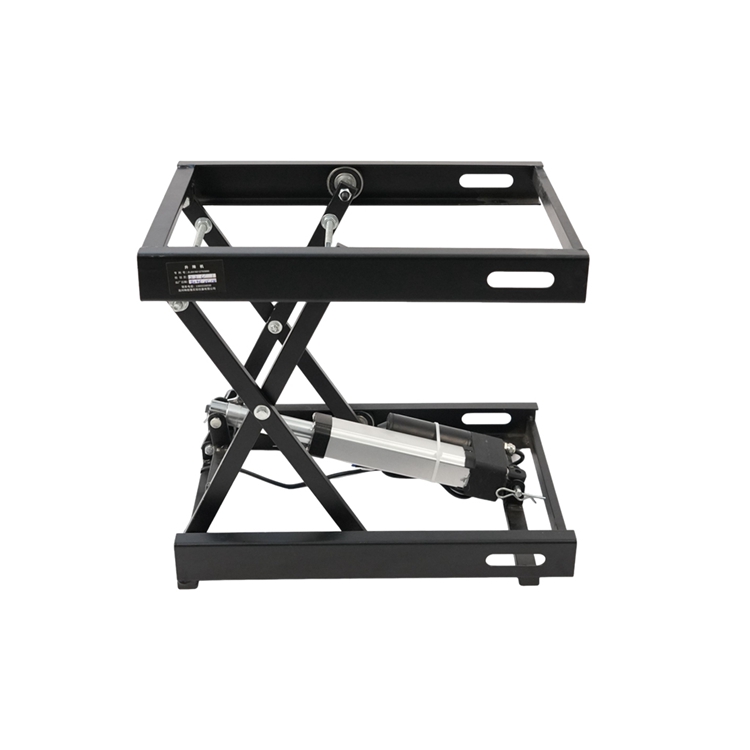
300x400mm Single Motor Single Scissors Lift Frame
Description: 300 × 400 mm Single Motor Single Scissor Lift Frame The 300 × 400 mm Single Motor Single Scissor Lift Frame is a compact lifting mechanism designed for applications requiring controlled vertical movement within a limited installation spac...
Whatsapp:+86 13463710111 +86 17633270825
Email:membershitzler@gmail.com
Product Description:
300 × 400 mm Single Motor Single Scissor Lift Frame
The 300 × 400 mm Single Motor Single Scissor Lift Frame is a compact lifting mechanism designed for applications requiring controlled vertical movement within a limited installation space. Its compact footprint makes it suitable for small work platforms, material handling equipment, inspection devices, and customized lifting systems.
The combination of a single motor and single scissor mechanism provides a relatively simple mechanical structure, making the system easier to install, operate, and maintain.
Structural Design
The main structure consists of scissor arms, pivot joints, a lifting drive system, mounting brackets, and a supporting platform or frame.
The single scissor mechanism uses interconnected arms that open and close around pivot points. As the scissor arms extend, the platform moves vertically. The structural dimensions and arm geometry determine the available lifting height, stability, and mechanical performance.
The 300 × 400 mm specification generally refers to the compact frame or installation dimensions, but the exact interpretation should be confirmed according to the manufacturer's technical drawing.
Single Motor Drive System
A single electric motor provides the power required to operate the lifting mechanism. Depending on the equipment design, the motor can drive a screw, hydraulic pump, gear mechanism, or other lifting transmission system.
The drive system should be selected according to rated load, lifting speed, lifting height, duty cycle, and installation conditions. Proper motor sizing prevents overheating and ensures stable operation during repeated lifting cycles.
The transmission mechanism should also provide sufficient mechanical strength and controlled movement to prevent sudden platform movement.
Scissor Arm and Pivot Design
The scissor arms are the primary load-bearing components. They should be manufactured from suitable structural materials with sufficient strength and rigidity.
Accurate pivot alignment is essential because uneven loading or excessive clearance can increase friction, vibration, and mechanical wear.
Bushings, bearings, or other wear-resistant components may be used at pivot points to improve operating smoothness and service life. Proper lubrication and periodic inspection are also important for long-term performance.
Manufacturing and Quality Control
Production typically includes steel cutting, drilling, bending, welding, machining, surface treatment, and final assembly.
Dimensional accuracy and welding quality are critical because manufacturing deviations can affect scissor alignment and lifting stability.
After assembly, manufacturers should inspect motor operation, lifting movement, structural alignment, fastening condition, and load-bearing performance. Safety-related components should also be tested according to the final equipment configuration.
Application and Selection Considerations
Before selecting a 300 × 400 mm single scissor lift frame, buyers should confirm rated lifting capacity, minimum and maximum height, motor power, lifting speed, platform dimensions, installation space, and duty cycle.
The actual working load should remain within the manufacturer's rated capacity. For customized equipment, the complete lifting system should be evaluated rather than selecting the frame based only on its physical dimensions.
Conclusion
The 300 × 400 mm Single Motor Single Scissor Lift Frame offers a compact and practical solution for vertical lifting applications. A rigid scissor structure, correctly sized motor, accurate pivot system, and reliable quality control are essential for stable and long-term operation.
For OEM and customized projects, the frame should be engineered according to the required load, stroke, speed, and installation environment to achieve the best overall performance.
References
ISO 12100 – Safety of Machinery: Risk Assessment and Risk Reduction
ISO 13849-1 – Safety-Related Parts of Control Systems
ANSI/SAIA A92 Series – Mobile Elevating Work Platform Safety Standards
ISO 9001 – Quality Management Systems and Manufacturing Quality Control
-

Key Components and Manufacturing Process of a Manual Lift Table
2026-08
-
Manual Lift Table Working Principle and Structural Design Analysis
2026-08
-
Key Components and Manufacturing Process of a Motorcycle Lift Table
2026-08
-
Motorcycle Lift Table Working Principle and Structural Design Analysis
2026-08